How to Take an Accurate Blood Pressure Reading at Home
Recommended picks


Prepare your body before you measure
What you do in the half hour before a reading can move the numbers. Try to avoid caffeine, smoking, and vigorous activity for about thirty minutes beforehand, and empty your bladder if you need to. Sit calmly for around five minutes so your body settles. Take the reading at a consistent time of day, since pressure naturally rises and falls. Doing this the same way each time makes your numbers easier to compare over time.
Get your posture and arm position right
Sit in a chair with back support and keep both feet flat on the floor rather than crossing your legs. Rest the arm with the cuff on a table or firm surface so the cuff sits at about the same level as your heart. Let the arm relax instead of holding it up, since muscle tension can affect the result. Place the cuff on a bare arm, not over a sleeve, and follow the position guide printed on the cuff. A slouched posture or a dangling arm can nudge a reading higher than it should be.
Choose and fit the right cuff size
Cuff fit is one of the most common reasons home readings drift. A cuff that is too small can read high, while one that is too large can read low, so check that your arm circumference falls inside the range the manufacturer lists. Wrap the cuff snugly with no twists, leaving room for a finger or two underneath. Many upper arm models, like the Greater Goods Batteries Included monitor (about 35 dollars, rated 4.4 with more than 28,000 ratings), include a cuff sized for a range of typical adult arms. If your arm sits at the edge of the listed range, look for a model or replacement cuff that fits you well.
Run the measurement and read the result
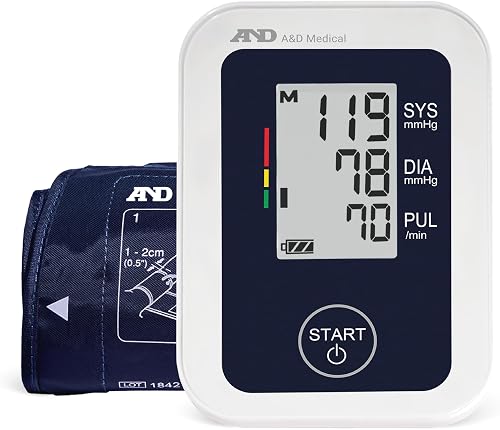
Once you are settled and the cuff is fitted, start the monitor and stay still and quiet. Resist the urge to talk, move, or check your phone while it inflates and deflates. The screen will typically show your systolic number on top, your diastolic number below, and often a pulse value. A clear, well lit display helps here, which is why some people prefer large screen models such as the Generation Guard GM-800A (about 60 dollars, rated 4.6 with over 6,000 ratings) or the A&D Medical UA-651 (about 32 dollars, rated 4.3 with over 4,000 ratings). Note the result rather than trying to remember it later.
Take repeat readings and keep a simple log
A single number can be misleading, so take two or three readings about a minute apart and look at the pattern. Many people discard the first reading and average the rest, but follow the steps your healthcare professional suggests. Write down each reading with the date, time, and which arm you used. A simple notebook or phone note works fine, though some monitors store readings for you. Over a few weeks this log gives a much clearer picture than any one measurement.
Know when to step back and ask for guidance
Home monitoring is a tool for tracking, not a substitute for professional care. If your numbers look unusual for you, change suddenly, or do not match how you feel, bring the readings to a healthcare professional rather than acting on them alone. Do not change any medication, treatment, or monitoring routine your clinician has set without talking to them first. If you ever feel unwell or have urgent symptoms, seek medical help straight away. HealthQuay is informational only and cannot interpret your results for you.
Common mistakes to avoid
- Skipping the rest period and measuring right after walking in, climbing stairs, or coffee.
- Using a cuff that is too small or too large for your arm, which can skew the result.
- Putting the cuff over a shirt sleeve instead of on a bare arm.
- Letting the arm hang or sit below heart level instead of resting it on a table.
- Talking, moving, or holding your breath while the monitor is inflating.
- Trusting a single reading instead of taking a few and comparing them.
Frequently asked questions
Which arm should I use for my reading?
Use the same arm each time so your numbers stay comparable, and rest it at heart level. Some people find a small difference between arms, so it can help to note which arm you used. A healthcare professional can tell you which arm is best for you to track.
How many readings should I take at one sitting?
Taking two or three readings about a minute apart lets you see whether they line up. Many people set aside the first reading and look at the rest. Follow whatever routine your clinician recommends for your situation.
Why do my home and clinic readings differ?
Readings can vary with posture, cuff fit, timing, and how relaxed you are, so some difference is normal. Some people also read higher in a clinic setting. Sharing your home log with a healthcare professional helps put the numbers in context.
Does the price of the monitor decide how accurate it is?
Price alone does not guarantee accuracy, and good technique matters a great deal. Budget upper arm models like the A&D Medical UA-651 at about 32 dollars and pricier ones can both serve home tracking well when used correctly. Consistent measuring habits often make the biggest difference.
Can a home monitor diagnose a health condition?
No, a home monitor is for tracking your numbers, not for diagnosis. It reports measurements as the manufacturer describes and cannot interpret what they mean for your health. Always bring your readings to a healthcare professional for guidance.